
Thank You
Thank you for your visit and for engaging with our services. Your support means the world to us! If you have any questions or would like to connect further, don't hesitate to reach out. We appreciate your time and look forward to sharing more valuable information with you in the future.
Blog
Blog
Scent Detection Terminology
Scent is a moving target, carried and distorted by the wind, forming a constantly changing, complex, landscape that is invisible to humans. As a detection dog handler, one of the most challenging parts of your job is figuring out how to help your sniffer dog get to where they need to be to find odor, rather than hindering them by blocking or pulling them away from scent. Therefore, understanding scent terminology, and how scent moves, is crucial to the success of your team.
This post begins with the most frequently used scent detection terms all beginners will need in their vocabulary. (Without these basics, it would be hard to follow most scent detection discussions, competitions, or articles). Below that, we provide a more detailed glossary of terms you might find helpful.
BASIC SCENT DETECTION VOCABULARY
Please note that for each term, if you conduct an internet search you will find droves of definitions. Experts ascribe differing meanings, and consensus is infrequent. Our goal in this post is to informally, practically, and briefly list how terms are commonly used.
Target Odor (TO) – the scent the sniffer dog is trained to detect e.g. handler scent, wintergreen essential oil in nosework, bed bugs, or medical samples, etc.
Hot – an object containing TO
Cold – an object that is free of TO
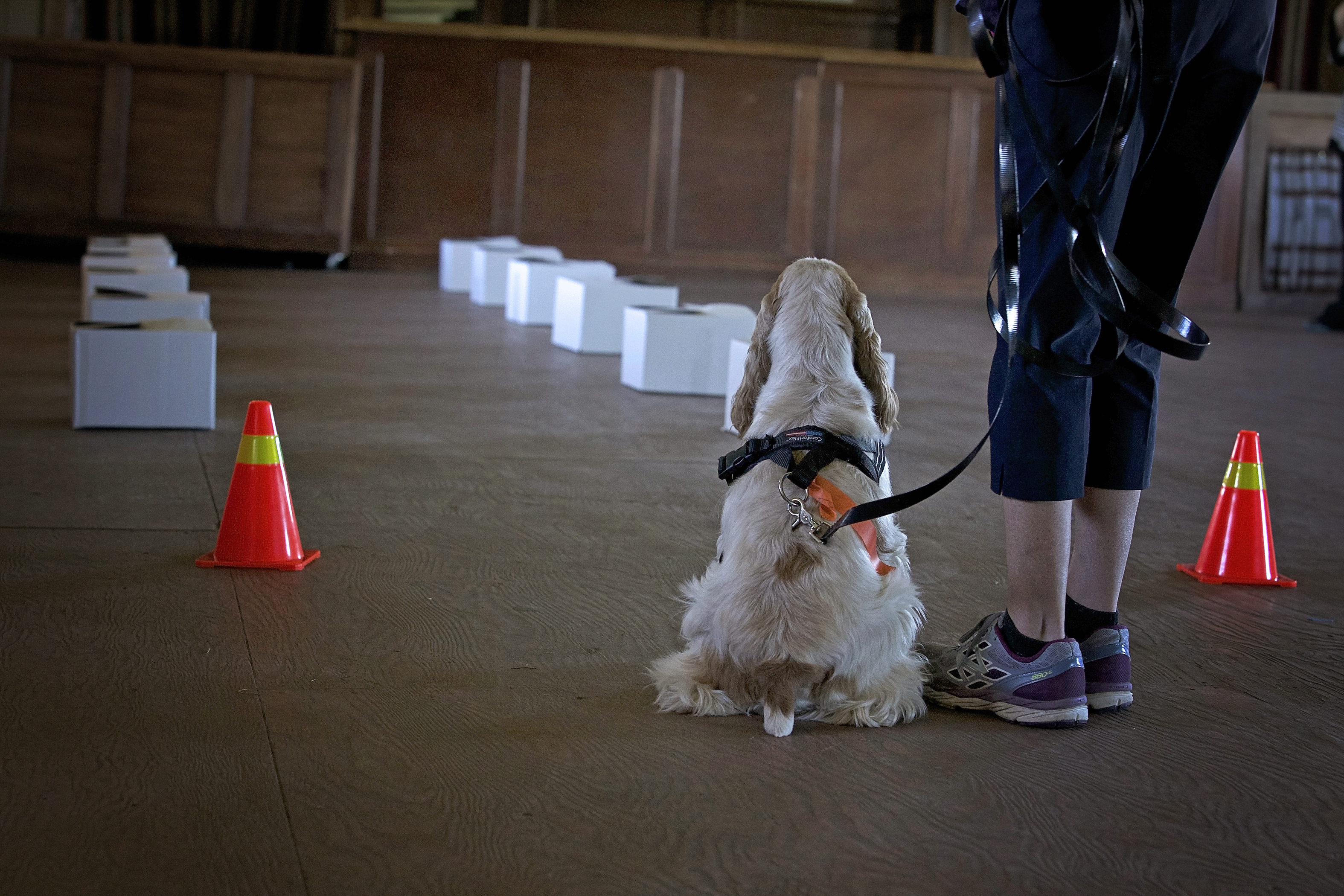
Lineup - a set of identical looking objects, which are distinguishable only by scent. The photo shows one type of lineup, a container search with 2 rows of identical, white boxes.
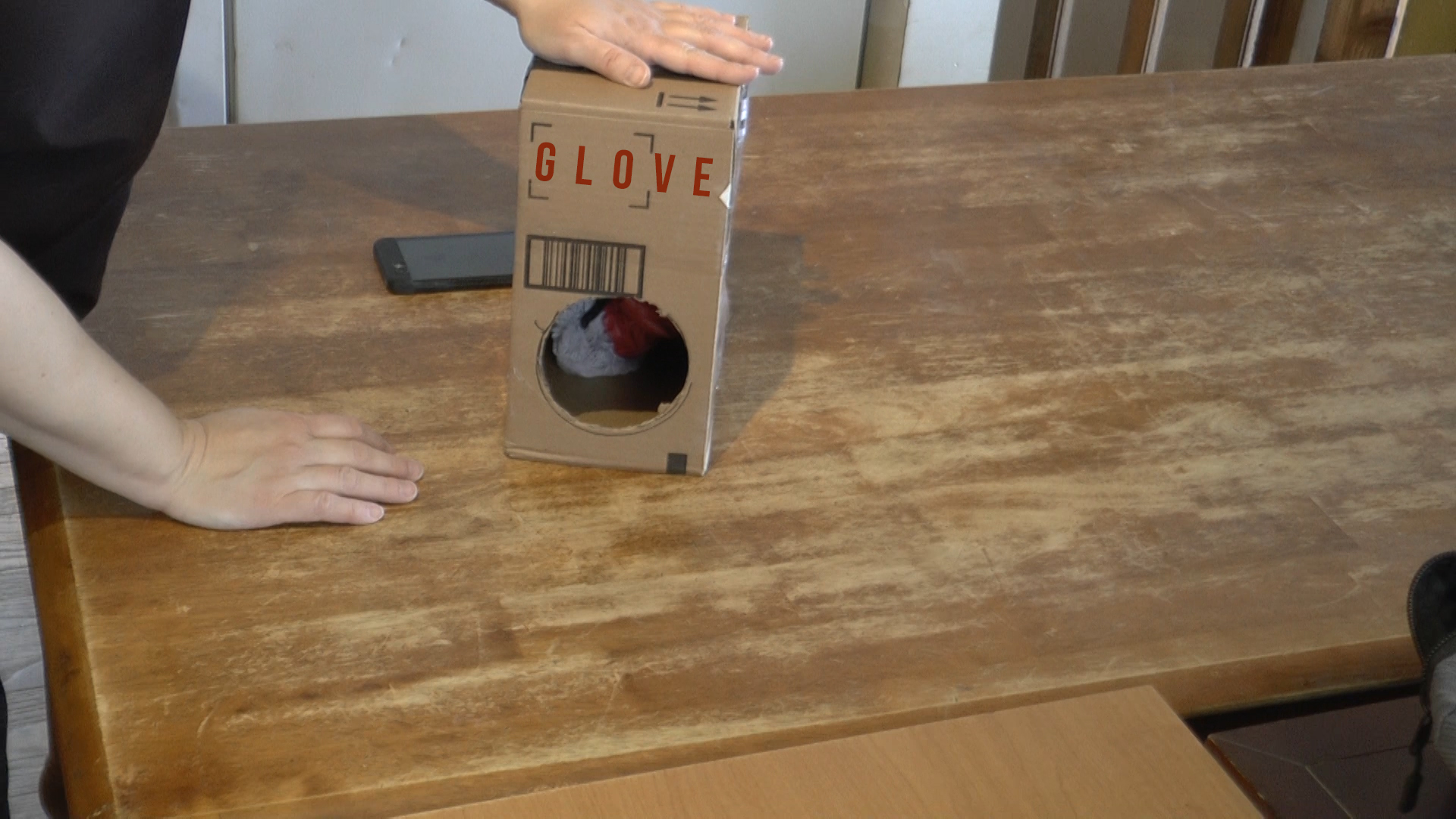
Hide - the package of target odor inside a vessel (which is placed inside the search environment). For example, for training handler discrimination, the target odor is the scent of a living person. This photo shows a kraft box with a hole (the vessel), which contains a glove worn by the handler (the hide).
In nosework, cotton swabs scented with essential oils are placed inside a tin, heat shrink tube, shipping envelope, etc. The hide is then placed into the search environment, like behind a license plate in a vehicle search.
Cocktail - a hide containing several target odors
For example, we train students to detect all 6 CKC scents by putting one drop of each of the 6 oils on a piece of unscented paper: Birch + Anise + Clove + Wintergreen + Pine + Cypress
The odors are not mixed up into a surprise soup! Each is a discrete drop on a piece of paper, or you can take one swab with each odor and place them all into a tin.
Another example is drug dogs training on a cocktail of several illicit drugs in the same bag.
Blind search – when the handler does not know where scent is located
Scent Cone - When there is a slow, constant wind, scent will be carried away from the hide in the direction of the wind, in approximately the shape of a cone. (Picture it like an ice cream cone). This airborne scent is also known as a scent plume.
This video captures a scent cone in slow motion. It is most concentrated near source, and less intense further away.
The longer the aging/soak time (between when a hide is placed into the environment and when the sniffer dog starts their search), the larger the cone gets, making it possible to detect far away. How far scent is carried varies (depending on the winds, elevation of the hide and barriers in the environment), but eventually scent will fall to the ground due to gravity. This video shows the scent cone from a smoke grenade on top of a boulder in real time.
Source – the highest concentration of odor. In the figure of the wood carton on the green background, source is the location inside the carton where scent is most intense (shown as the blackest area in this figure).
Scent detection tests and competition usually specify how precisely the sniffer dog must locate source. For example, in higher levels of some scent detection competitions, the handler must pinpoint the location of source within 2-6 inches, or about the size of a Post-it-note.
Fringe alert - In this type of error, the handler thinks source is one place, but it is further away than the rules allow e.g. the handler thinks the scent is the top right corner of the carton, but the judge placed it in the bottom left corner. Fringe alerts may be faulted or failed.
False alert - when a team alerts in the absence of target odor. They think they found the hide when no hide is present.
Missed hide - when a team fails to alert when target odor was present. They fail to find the hide, when scent was present.
Aging – the time between when the hide is placed and when the first dog starts searching e.g. 15 minutes.
Odor recognition means that the dog can demonstrate that they recognize the target odor. In nosework competition, the odor recognition test is frequently a blind search of 12 boxes. The handler would have 2 or 3 minutes for their dog to search and determine which box is hot.
Indication aka Trained Final Response (TFR) - a behavior chain the dog performs when they find the source of target odor e.g. dog puts their nose at source, stares at it, sitting frozen like a statue, until released to the reward by the handler.
Clear - a search area that contains no target odor.
Elevation - the height of the hide above the ground, or above a level surface e.g. on an airplane, the sniffer dog on may stand on a passenger seat to search the luggage bin 4 feet above.
Alert – The response the dog offers when they have located target odor. To notify the certifying official, the handler usually calls out "alert" (and may raise their arm). Alerts may be:
passive e.g. freeze, sit, down, stand, stare, or
active e.g. scratch, bark, paw, retrieve, etc.
aggressive alerts – when a dog scratches, bites, or disturbs hot objects in a way that they contaminate the search environment. Aggressive alerts are undesirable in most disciplines, causing faults or failure.
GLOSSARY OF SCENT DETECTION TERMS
The following is a more detailed list of scent detection training terminology.
Air Scenting – Technique a dog can use to locate target odor where they search wind or air currents.
Ageing – The amount of time between placing a hide and when dogs begin searching. During this time odor disperses into the surrounding air, making it easier to find. Generally, try to age for at least 5 minutes. Train for short and long ageing so your dog is accustomed to different scent profiles.
Aggressive Alert – When a dog scratches or bites at source, resulting in a fault being incurred for disturbing the hide.
Alert – The pre-determined response the dog offers when they have located target odors. The handler says alert (and may raise their arm) while their dog is indicating source to let the judge know they have found the location.
Altered aka fixed aka spayed or neutered – The technical term for a dog of either gender which has been surgically made unable to reproduced.
Benching/ Benching area – To set up one’s belongings, dog crate, etc. in a designated area at a competition while the handler waits between turns competing.
Blind – A type of search where the handler doesn’t know the location of the target odor, since it was hidden by somebody else.
Blocking – When a handler is standing in the dog’s way and prevents the dog from searching or moving to that position. For example, if a handler is standing on top of a hide, he is blocking his dog.
Bracketing – The dog moves left and right, back and forth, searching for the scent cone.
Breed Standard – The blueprint for the ideal specimen f a purebred dog of a certain breed, including functions for which it was bred, appearance, temperament, size, colors, etc. Breed standards may vary between countries and between registering bodies e.g. United Kennel Club vs Canadian Kennel Club, Federation Cynologique Internationale, etc.
Canadian Kennel Club (CKC) – The primary registering body for purebred dog breeds in Canada, which compiles breed standards, organizes events, specifies rules, governs judges, etc.
Clear – When a handler determines that his dog has completed the search of an area and no target odor is present, they say “clear” to communicate that to the judge and stop the timer’s clock.
Cocktail – A combination of more than one target odors e.g. in our classes, students find Birch + Anise + Clove + Wintergreen + Pine + Cypress. To prepare a cocktail, place a drop of each odor in a separate location on a piece of lab paper (rather than combining them into a soup which may have unpredictable chemical reactions).
Cold – A box or object without target odor (vs hot is a box that contains target odor)
Contaminated a) If the handler drops food in the search area, they are usually faulted for contaminating the area. b) When scent is mistakenly taken from where it should be in a clearly marked container to an area that should be free of it. As a result, handlers may be confused when dogs don’t search or react as expected.
Correction – Punishing a dog e.g. using a leash pop or jerk, shouting, which may be faulted by the judge as unsporting behaviour, or dismissed if the treatment of the dog is overly harsh.
CWAGS (Canine Work and Games) – An organization that offers titles in scent, obedience, rally obedience and games.
Commitment to Odor aka Odor Commitment – When the dog has value for odor, forms a positive association, and odor becomes rewarding.
Dismissed – Asked by a judge or official to leave a search or competition e.g. if a dog bites a spectator during a trial.
Distraction – An intentionally distracting toy or food e.g. tennis ball or peanut butter may be placed inside a search environment by the judge, or the environment contains existing distractions e.g. gopher holes, smells of other dogs
Elements – Different search environments may be defined and tested by host organizations e.g. In UKC nosework competition, there are 4 Elements:
Container – Inside a box. The dog searches a row of boxes. To increase the difficulty, more boxes, different shapes, and distractions may be added.
Interior – The hide is secured inside, underneath, between or on top of objects inside a building. For example, the dog may search an office where the hide is taped under a chair.
Vehicle – The hide is secured on the outside of a vehicle, for example, on the front bumper. More advanced searches include more vehicles, and several types of vehicles e.g. buggies, ATVs, or tractors.
Exterior – The hide is secured around an object outside. Surfaces may include grass, gravel, leaves, snow, etc. Because of changing wind and weather conditions, and frequency of animal smells including urine, this is the most difficult type of search.
Elimination – Dog urinates, defecates, or vomits in the search area, usually resulting in failing that search
False Alert – The handler calls and alert when there is no odor present, but the dog has indicated, or when the room has odor present, but the dog indicates in the wrong location.
Finish a) Complete all of the requirements for a title b) Once all the hides in a search are found, the handler must say “finish” to stop the clock. If the handler doesn’t say finish, they may be faulted of failed.
Focused Response – An indication where the dog freezes and stares at source with intense focus
Formal Indication – Dog is trained to perform a sit or down as his alert behavior.
Fringe – A fringe alert occurs when the dog indicates close to the target odor, but not at source. For example, the dog indicates by lying down on the driver side of a vehicle when the hide is actually on the front bumper and wind is blowing scent to the dog’s location. This is a very common error that may occur when the dog has a training deficiency and responds on lower thresholds of odor and does not work odor truly to source. Depending on the test or competition host organization, fringe alerts should be faulted or failed, and measurements/guidelines on what is close enough may be included in the rules.
Handler Discrimination – A scent detection search where the target odor is the handler’s scent. Usually, the handler wears a glove before handing it to an official to hide in the search environment.
Handler Error – The handler makes an error when the dog’s performance may have been without fault. For example, the handler may call an alert twice on the same box in a container search.
Head Snap – The dog makes an abrupt change of direction when they pick up the scent (like when a human does a "double take", when they notice an object of interest)
Hide – The package of target odor inside a ventilated container that is hidden in the search area for the dog to find. For example, one common type of hide is cotton scented with target odor inside a metal tin with magnets, which easily secure the hide to a metal surface. Other favorite hide containers include metal tins with holes, shipping labels, plastic tubes, etc.
High in Trial – The award given to the team with the fastest search.
High Value Rewards – Spectacular rewards the dog finds highly motivating, even in what might otherwise be a distracting situation. For example, a dog might be very excited about steak rewards (high value), while they would not always be interested in a piece of lettuce (lower value).
Hot – The box containing the hidden target odor is called “hot.” The empty boxes without scent are called “cold.”
Indication – The behaviour (or chain of behaviors) the dog displays to show that they have made a decision about the exact location of the target odor e.g. freeze like a statue with eyes staring at source.
Intact – A dog that can sexually reproduce; not spayed or neutered.
In season aka Estrus aka in heat – The stage in a female dog’s reproductive cycle during which she becomes receptive to mating with males. Females in season are ineligible to compete in some scent detection events.
Judge’s Briefing – The judge shows competitors the search area and explains relevant details such as the start line, any safety concerns, the time available, then recaps applicable rules and/or responds to questions from competitors.
Junior Handler– A young participant, generally under 18 years
Kibble – A slang term for dry commercially available dog food (as opposed to moist diets, raw food, etc.)
Lab, Scent Detection – An arrangement of boxes and drawers used to teach new dogs how to systematically search for target odor and to indicate (see Andrew Ramsey’s training video). In Hunter’s Heart scent detection lab, the white cardboard boxes have 3 inch diameter holes in them. The hide container e.g. tin containing scented paper is taped inside the box close to this hole. So we know when the dog’s nose is inserted into the hole, that he is very likely smelling the highest concentration of target odor. This makes our criteria for success very concrete, resulting in more timely, clearer rewards.
Leaving Source – The dog leaves the target odor location.
Leg – One passing search towards a nosework title e.g. a team passes one novice container search, where two passes may be required to complete a title.
Luring – A handler places a reward in front of the dog’s nose and moves it to elicit a desired behavior. For example, when a handler places a cookie at the dog’s nose and draws them away from an odor.
Match – An informal event without strict rules, used to practice and gain experience.
Multiple Hides – A search where more than one hide is placed in the area. For example, a Superior level container search may include one box with a clove hide and another box with either a birch or anise hide.
Move-up – When a handler has entered and event, but subsequently completes a title, they have the option to continue to compete as entered in the B class or fill out a move-up form to advance to the next level. For example, a UKC handler completes their novice container title in Trial 1 on Saturday and completes a move-up form so they can compete in Advanced Containers in Trial 2 on Sunday.
National Association of Canine Scent Work (NACSW) – A scent detection governing body, which offers competitions, trains officials and judges and promotes the sport of nosework.
Premium List – A description of an upcoming event, describing target odors, events & levels offered, location, fees, judge, etc.
Reward placement – the physical location where the reward is delivered. While the dog is enjoying his reward, he is continuing to smell the target odor. Because rewards appear at source, the dogs learn to focus their attention at source, clearly communicating where it is, which is very helpful during blind searches.
Scent detection aka nosework – An activity whereby a dog (or other animal) searches for a specific scent. In canine scent detection, dogs are trained so they know in advance which scent or target odor to search for.
Source – When the dog smells the odor, they are trained to find the “source,” also called “sourcing”. The “source” is the highest concentration of odor. For example, if the dog is searching a vehicle where odor is hidden behind the license plate, the source is the exact position on the license plate where it is located, within 2-6 inches e.g. behind the red year sticker. While the dog is actively searching around the license plate, they are close to the source, but not “at source.”


THE BEAST BOUTIQUE LTD.
Monday to Friday: 6am-6pm
Saturday: grooming by appointment.
587-317-5404
6115 4 St. SE Unit 4
Calgary, AB T2H 2H9
[email protected]

FAQS
What does pet insurance cover?
Our pet insurance plans are designed to cover a wide range of situations to keep your furry friend healthy and happy. This includes accidents, illnesses, surgeries, diagnostic tests, hospitalization, prescription medications, and even preventive care like vaccinations and annual check-ups. We're here to provide comprehensive coverage for your pet's well-being.
Are there breed or age restrictions for coverage?
No, we believe that every pet deserves access to quality healthcare. That's why we have no breed or age restrictions on our coverage. Whether your pet is a playful puppy or a wise old companion, our insurance plans are open to all breeds and ages. We're here to protect pets of all kinds.
How do I file a claim, and what's the process like?
Filing a claim with us is straightforward and hassle-free. When your pet receives treatment, simply collect the necessary invoices and medical records. You can then submit your claim online through our user-friendly portal. Our dedicated claims team will review your submission promptly. We strive to process claims quickly so you can get reimbursed for eligible expenses. We're here to guide you through the process and make it as simple as possible, ensuring your pet gets the care they need.